Tuesday, June 3, 2014

A Urine Tax

Although Urinetown poses a supposedly far-fetched and ridiculous premise in its imposition of a fee for peeing, the actual history of that kind of taxation may surprise you.  The first Urine Tax in known history was first imposed by the Roman Emperor Vespasian, who ruled in the late first century.  Urine was known to contain several valuable chemicals (notably ammonia), which were used in the tanning and laundering industries at the time.  Urine was collected from the upper classes, and a tax was imposed on those who wished to purchase this valuable resource. 

The Urine Tax (or vectigal urinae, in the original Latin) was considered a disgusting policy by Vespasian's son, Titus. When Titus complained about it to his father, Vespasian was reported to have picked up a gold coin and remarked, "Pecunia non olet", or, "Money does not stink".  This was perhaps the most famous phrase ever spoken by Vespasian, and has remained with us ever since, now commonly spoken to downplay the questionable (or outright illegal) sources of financial gain.  [BTW:  Some of the original Urine Tax no doubt went toward the construction of the Roman Coliseum, which was built during Vespasian's 10-year reign.]

The Coliseum notwithstanding, Vespasian's contribution to modern architecture can be seen in one other notable way: because of his famous Urine Tax, public pay toilets in some parts of the French-speaking world became known as Vespaciens.  To the left is an example of a Vespacien built in Montreal in 1930. Although the concept of pay toilets is completely novel to most Americans, certainly those of your age, the concept of a fee for pee, is widespread throughout Europe's major cities (especially Paris).

While pay toilets are fairly rare in the United States today, we did go through a period, in the 1950s and 60s, during which they were very common.  The first recorded American establishment to install a pay toilet was "Walt's", a restaurant built on Hollywood Boulevard in 1935 by none other than Walt Disney.  From there, pay toilets spread throughout the country, most often located in bus stations and airports, places where their need was exceptionally strong (e.g., after a long trip) and the public was willing to pay the fee. Eventually they started popping up in department stores and shopping malls, which is where I think I saw my last American pay toilet when I was a boy.

By the 1970s, though, political unrest had begun to build, and a grassroots movement to ban the use of pay toilets began to grow. One of the largest organizations opposed to the use of pay toilets was the Committee to End Pay Toilets in America (or CEPTIA, I'm not making this up), founded by 19-year-old Ira Gessel:

When a man's or woman's natural body functions are restricted because he or she doesn't have a piece of change, there is no true freedom.               --  Ira Gessel

Freedom through complimentary urination.  Set that quote to music and you have another production number for Urinetown. I am proud to note that Chicago was the very first city to ban the use of pay toilets in 1973, and by the end of that decade pay toilets were virtually unknown in the U.S.  But take some change with you if you visit a train station in parts of Europe, where the act of using a public toilet became euphemistically known as "dropping a penny".

Monday, June 2, 2014

Happy Endings

After a week hiatus (here's hoping Finals Week went well for everyone), we're back, and will be posting frequently until rehearsal starts (three weeks away!). Hopefully, the school year ended (or is ending) happily for everyone.

Let us now segue from that sentiment to a broader discussion of happy endings, at least those that have typically been found in the traditional Broadway musical.  After World War II, the defining characteristic of the musicals penned in that Golden Era was unfettered optimism. Mirroring the general mood of the populace at the time, the Broadway musical affirmed what everyone already knew to be true; specifically, that

1.  Love is the answer, and
2.  Be true to yourself, and everything will work out fine.

I think that it is strongly arguable that virtually every single Broadway musical written in the middle decades of the 20th century was based upon either one, or both, of these maxims.  Just consider the playlist of these popular Broadway show tunes:

Oh, What a Beautiful Morning!, Oklahoma, 1943
Happy Talk, South Pacific, 1949
A Cockeyed Optimist, South Pacific, 1949
I Whistle a Happy Tune, The King & I, 1956
Everything's Comin' Up Roses, Gypsy, 1957
Put On a Happy Face, Bye Bye Birdie, 1960

Of course, in reality, the two happy maxims noted above are frequently found to be wanting. Nearly half of all marriages end in divorce, so love is apparently not always the answer, and being true to yourself often gets you in a lot of hot water (think Edward Snowden).  Starting in the mid- to late-sixties, the general mood of the country turned sour, and Broadway started to embrace some darker themes, especially through the 1970s.

The crown prince of the depressing Broadway musical is surely Stephen Sondheim, whose amazing ability to craft complex and intricate lyrics and musical compositions will have to be discussed another time. Here, we'll focus on Sondheim's willingness to buck the trend, and deny the audience the happy ending they are hoping for:

Company, 1970:  You may never find a soulmate or experience true love.

Follies, 1971:  You may die old and alone, after living a lifetime of regret.

Sweeney Todd, 1979:  Everyone you love may be taken from you, and made into meat pies.

Sondheim went on to fashion what many people think is one of his defining works, Into the Woods, 1987, a musical which expressly sets out to dispel the myth of the fairly tale ending. Into the Woods features our favorite fairly tale characters being taught a series of true life lessons through songs titled, Agony, I Guess This is Goodbye, Witch's Lament, Your Fault, and No More.  This last song shows us a humble baker whose hopes and dreams have all been crushed by the reality of the world.  He begs the universe to free him of its endless torments, his own version of "crossing the river":


No more riddles, please.
No more jests.
No more curses you can't undo,
Left by fathers you never knew.
No more quests -

No more feeling -
Time to shut the door.
Just....no more.

Urinetown is almost the defining example of the post-modern Broadway musical.  Not only is Urinetown post-Vietnam, post-Watergate, and post-Gulf War, it also is quite literally the first musical to open on Broadway post-9/11.  It echos the social despair of the Sondheim musical, but without any of the thoughtful retrospection; instead, Urinetown beats us over the head and makes fun of us for being stupid enough to believe in true love in the first place.

We don't even make it to Intermission before one of our lovers kidnaps the other one for political leverage.  Our hero dies a brutal death alone, and without any sort of self-sacrifice that provides any benefit for those he leaves behind.  His former love interest takes up the mantle of bloody vengeance, with the intent of murdering her own father, and the entire cast suffers a crippling and fatal drought at the end of the show.  It almost makes Curly's admiration of corn as high as an elephant's eye seem trite by comparison.

Tuesday, May 27, 2014

An Unusual Perspective

We have been discussing only the artistic content of the show so far, and in some depth, so today for a change of pace, I'm going to address one of the technical aspects of the Urinetown. This show makes fun of just about everything theatrical, including the technical facets; there are lighting jokes, costume jokes, and set design jokes built right into the script, and we won't shirk from them.  For now though, let's talk about our set.

I'll give you a tour of the complete set design later on, but for now, let's focus on one particular aspect of the set:  the use of forced perspective. Given the economic and political themes of the show, we wanted the overall feel of the set to be oppressively large and uniform, to suggest the totalitarian nature of the place in which our characters live.  We decided upon fat and blocky-looking walls, constructed of institutional, cinder-block-sized brick (much like that used in most high schools).  In order to make the repeating structures look much larger than they actually are, we use a trick of forced perspective.  The buildings closest to the audience are the tallest (at 18 feet high, nearly the entire height of our stage area).  But the buildings placed further upstage are far from identical, as shown by a side view:


The front view makes it look as if three identical, chunky "cell-blocks" are lined up on both sides of the stage, extending a great distance.  In reality, as revealed by the side view, they are actually much shorter and narrower than they appear, allowing for a grander sense of scale.  As long as the angles and distances are carefully calculated and constructed,  the illusion can be very powerful.


We have used this kind of strategy before on the BRAVO stage. Most recently, the set design for In The Heights used forced perspective to give the illusion of being surrounded by towering brownstones on the upper West side of Manhattan. Here, the horizontal angles were less pronounced, but the perspective in the vertical direction was even sharper.  Each of these buildings comprised four stories (though the top story was barely visible), with each successive story constructed slightly smaller for a sense of realism.  The resulting unusual angles for all of the doors, windows, trim, and bricks made this set a nightmare to construct and paint.  Ironically, if the set team handles the forced perspective properly - the audience never even notices.


Another recent BRAVO show that used forced perspective in a different way was Hairspray Jr. In the finale of that show, three gigantic hairspray bottles appeared on stage as studio props. But two of these were constructed at only half-scale, and were placed further up and back of the bigger can, to give the illusion that they were all the same size, and the stage was much deeper than it actually was.

A much trickier use of perspective, though, was the opening flat for Tracy's bedroom, making it appear that we were looking down at Tracy, who was waking up in her bed.  This perspective trick required building the side tables, lamps, and headboard all in three-dimensional forced perspective; no mean feat.  The master carpenter for that show, Tom Ziobro, had more than 25 years of experience building theatrical sets, but retired from set construction immediately after Hairspray.  I'm not saying there's a direct connection.  But forced perspective can be hard.

Saturday, May 24, 2014

Second Saturday Contest

It's another Saturday, and time for another contest.  No essays are required.  I have hidden the word URINE somewhere in one of my previous posts (you may need to check the archive).  No, the word "Urinetown" doesn't count. The FIRST cast member who posts a comment to this post identifying the correct location of the hidden URINE wins a Urinetown promotional roll of toilet paper, pre-signed by the original cast from 2001. Happy hunting!

Friday, May 23, 2014

Crossing the River

When I was about the same age as you are now, I belonged to a volunteer performance group called the Civic Singers of Toledo (my hometown).  The Civic Singers was a group culled mostly from the choirs of various local churches, who performed each Monday night a secular program for a rotating group of nursing homes and retirement communities.  The women wore formal gowns, and the men wore red jackets, white shirts, and black bow ties.  I was in high school, and the average age of the remaining group members was well over 60; my involvement with this group is one of the fondest memories I have of my hometown.

While the program we performed would change from year to year, one song that always made it into our repertoire was Deep River, an old spiritual of African American origin.  It started out so slow and quiet that you could barely hear the singing, but by the time we reached the bridge, the volume rose to a focused intensity, and the house nearly shook with an emotional crying out:
Deep River.  My home is over Jordan.  Deep River, Lord, I want to cross over into campground.
Oh, don't you want to go, To the Gospel feast; That Promised Land, Where all is peace?
Oh, Deep River, Lord, I want to cross over into campground.
The beauty of the song left an impression on me (even now I can sing the baritone part by heart), but I didn't really think too much about the lyrics at the time.


What are frequently referred to today as 19th-century Negro spirituals were generally created by enslaved African Americans, usually of Christian origin, as a direct response to the abject misery and woe that frequently comprised their lives.  The Jordan River is frequently mentioned in these spirituals, a fact I noticed, but didn't think about too much as a teenager.  The symbol of the Jordan River was borrowed by the slave community directly from the Jewish tradition; this was the river that the Hebrews finally crossed to reach the promised land.  As it turns out, the Jordan River was also an unofficial name enslaved African Americans gave to the Ohio River, north of which lay all of free states.  Crossing the River Jordan, then, was a symbol for escaping to freedom, of reaching the promised land, and what would surely be a better life.  These dreams of escape made their way into any number of spirituals, usually sung by the enslaved, the miserable, and the bereft.

In reality though, very few of the enslaved actually escaped, and those that did never experienced the utopia they were hoping for.  After hundreds of years of oppressive slavery, the River Jordan began to symbolically represent something else - the only hope left available to the hopeless after years of despair - the hope for a quick and peaceful death.  Countless numbers of early spirituals, if listened to with a careful ear, never express a hope for freedom, or a better life, or anything with any degree of optimism.  Instead, these spirituals all pine desperately for the day that their singers can finally be with their maker, free of the daily torment, and at long last at peace.  Imagine the kind of grief and melancholy you must feel to have your only true wish to be for a restful and timely death.  To sing Deep River was to understand a sorrow so great that only death could offer relief; heady stuff for a 16-year-old in a red coat and bow tie.

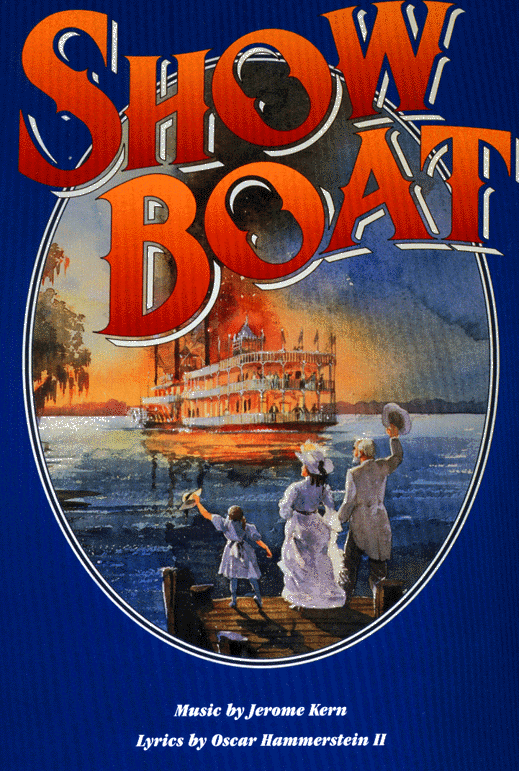
Some years later, I found myself rehearsing for a dinner theatre production of Show Boat in the same town.  I had been cast at the age of 20 as half of the entire male chorus (the Westgate Dinner Theatre didn't boast a big stage).  Deep River had actually been included in the original version of Show Boat, but at 4-1/2 hours, the show needed to be cut, and Deep River didn't make the grade.  But a snipet of another spiritual song, Mis'ry's Comin' Round, remained in Act I, sung by the black chorus.  Our music director decided to cut this brief song as well.  After all, he explained, the song was rather slow and boring, and didn't advance the plot.


Our director, based in New York, flew in shortly thereafter, and once he learned of the cut, he threw an enormous tantrum, and immediately restored the song.  The director gathered everyone in the rehearsal room, where he explained at length the underlying historical context for the lyrics of the song, and described the emotional power of its underlying yearning for death.  After his explanation, the music director sat at his piano and quietly played the first plaintive notes of the piece; the actors looked at each other, and then started to perform the song with a new understanding.  No one watching this new performance was unmoved; I remember having tears in my eyes as I listened to the black chorus pour what sounded like a lifetime of pain into their singing.


I remembered that experience some years later still, when I was directing a production of Big River (the musical version of the Adventures of Huckleberry Finn).  Big River contains a scene featuring a number of slaves who are chained together being transported by their masters in a skiff across the Mississippi River.  Along the way, they sing The Crossing, which of course isn't really about crossing a river. Have a listen:


It almost seems crass and obvious to mention that Urinetown takes this Negro spiritual river motif, and turns it on its head.  At the end of Act II, Hope launches into I See A River, first by mimicking the voice of a gutsy blues singer, to establish her gospel roots (a strange juxtaposition for such a rich white girl).  The river that Hope sings about represents something for which her people are desperately yearning; but here, the river doesn't represent freedom, or equality, or even a peaceful death.  In the midst of an oppressive drought, this river represents - water.  Using a river as a metaphor for water is about as literal an interpretation as any found in the show, and is an appropriate final jolt for an audience that has by this time, suffered enough.

Wednesday, May 21, 2014

A Guest Submission

An unofficial submission to our recent contest by Gussie Lenehan (the redoubtable mother of Aidan) was interesting enough that I thought it merited special note.  Gussie felt that Run, Freedom, Run reminded her of Gonna Build A Mountain, from Stop the World, I Want to Get Off (1961).  Gonna Build A Mountain is a fine answer - it certainly owes a great deal to the gospel tradition.  But there's even a closer similarity between these two songs that I hadn't noticed before.

First, listen to the first stanza of Run, Freedom, Run:


Then listen to the first stanza of Gonna Build A Mountain:


These two songs not only share exactly the same melody for the first four measures, they use an identical chord structure for the entire verse.  Kudos to Gussie, and her keen ear!


Side Note:  Stop the World, I Want to Get Off opened first in London, and didn't make it to Broadway until 1978, some 17 years later.  It's an odd, abstract little piece, based around the concept of an entire man's life (Littlechap), from birth to death, being represented by a circus. Sammy Davis Jr. starred in the Broadway version, which lasted for exactly 30 performances. The miracle is that anyone remembers this show at all (and for the most part I'd like to forget it). But Sammy made one song from the show his own, and his personal fame managed to keep this song in the public consciousness:  What Kind of Fool Am I?

Freedom Rocks the Boat

In the mid-80s, I directed a high-school production of Fiddler on the Roof, a show I know some of you have recently experienced for yourselves. Fiddler is a strictly staged and scripted show, and there isn't really too much room for individual creativity in its direction, but once in a while you find a moment or two of inspiration.  I had cast the role of Fruma-Sarah (the scary ghost of the butcher's dead wife) with an African-American girl, who had an absolutely incredible voice.  When she reached the point in the dream sequence where she utters her final curse, I had her start riffing Whitney Houston-like all over the map, powering out a huge note of threat at the end, a startling departure from the way this show is typically sung.  A nice Jewish play, with a touch of Aretha Franklin.

Neither Whitney nor Aretha learned their vocal craft in a Motown studio, but rather in a church, singing powerful gospel songs with their local choirs.  And ever since strong gospel singers have been available, they have had a strong influence on Broadway.  Entire books have been written about the history of gospel music in musical theatre, so I won't try to retread that ground here.  But a couple of highlights are worth noting.


Langston Hughes, known as the "Poet Laureate of Harlem," played an important role in the Harlem Renaissance in the 1920s.  Hughes wanted to capture the common experiences of Black America in his writing.  In 1961, Hughes wrote the gospel song-play Black Nativity, a retelling of the classic Nativity story, using an entirely black cast, Christmas carols sung in the gospel style, and some original poetry.  Black Nativity opened in December 1961 off-Broadway, and was one of the first plays written by an African American to be staged there.  Ever since the mid-90s, Black Nativity has been staged annually in a Seattle theatre, and has become a strong cultural tradition.  Black Nativity went on to influence both of the rock gospel shows, Jesus Christ Superstar and Godspell.


Many gospel shows were to follow:  Trumpets of the Lord (1964);  But Never Jam Today, an all-black re-telling of Alice and Wonderland (1969);  Purlie (1970), whose signature song Walk Him Up I used to perform with my high school show choir (though we were mostly white, and I got to sing the black lead);  The Wiz (1975);  Your Arms Too Short to Box With God (1976);  Bubbling Brown Sugar (1976);  and finally, The Gospel at Colonus (1983), a re-telling of Sophocles' Oedipus Rex, a nearly perfect example of the form.

I include a promotional clip for The Gospel at Colonus below - it's a long clip, so you can just sample it, but get the flavor. Yes, that's Morgan Freeman.


These were all shows with entirely black casts, black production teams, and for the most part, appealed primarily to black audiences.  But gospel music had for a long time been seeping into the mainstream of Broadway, most often in the form of a big production number, typically found in Act II of a big musical.  Examples of a gospel-style song in a mainstream Broadway show are so numerous it's almost silly to try, but see how many you recognize from my very abbreviated list below:


"Get Happy" from The Nine-Fifteen Revue (1930)
"Blow, Gabriel, Blow" from Anything Goes (1934)
"Great Come and Get It Day" from Finian's Rainbow (1947)
"I'm On My Way" from Paint Your Wagon (1951)
"The Brotherhood of Man" from How to Succeed... (1961)
"We Beseech Thee" from Godspell (1970)
"Brand New Day" from The Wiz (1975)
"Black & White" from Barnum (1980)
"Holier Than Thou" from Nunsense (1985)
"'Til We Reach That Day" from Ragtime (1998)
"A Joyful Noise" from Bat Boy (2001)
"I Know Where I've Been" from Hairspray (2002)
"Prayer of the Comfort Counselor" from Spelling Bee (2005)
"Freak Flag" from Shrek the Musical (2008)
"Raise Your Voice" from Sister Act (2011)

Each one of the above is a huge gospel-style number, almost always situated in Act II, which tends to top everything preceding it.  Gospel numbers just seem to be natural show-stealers.

Sooner or later, you know I'm going to try to tie all this back to Urinetown somehow, and here's where it happens.  The third production number in Act II of Urinetown is "Run, Freedom, Run", a tent-revivalist, gospel-style song, complete with testifying and faith-healing.  It's gospel roots are unquestionable, and it openly acknowledges the debt it owes to all of the gospel production numbers that have preceded it.  In my mind, though, the particular style of "Run, Freedom, Run", as sung by Bobby Strong, pays particular homage to two specific Broadway standards.


The first of these comes from Big River, in it's Act II blockbuster "Waitin' for the Light to Shine". This number is sung by the young Huck Finn, another rascal; both young rabble-rousers are preaching about the healing power of optimism (although it doesn't ultimately pan out so well for Bobby Strong).  Listen to a bit of "Waitin' for the Light" below:


Run, Freedom, Run even mimics Waitin for the Light's a cappella choral break in the middle of the song.  An easy forerunner found here.

But the most obvious acknowledgement that Run, Freedom, Run makes is to the Act II show-stopper found in Guys and Dolls.  In the 1950 Broadway classic (since revived five times), a group of crusty gangsters find themselves at a prayer meeting due to a lost bet.  One of their number, Nicely-Nicely, stands up and begins to testify.  Have fun!